


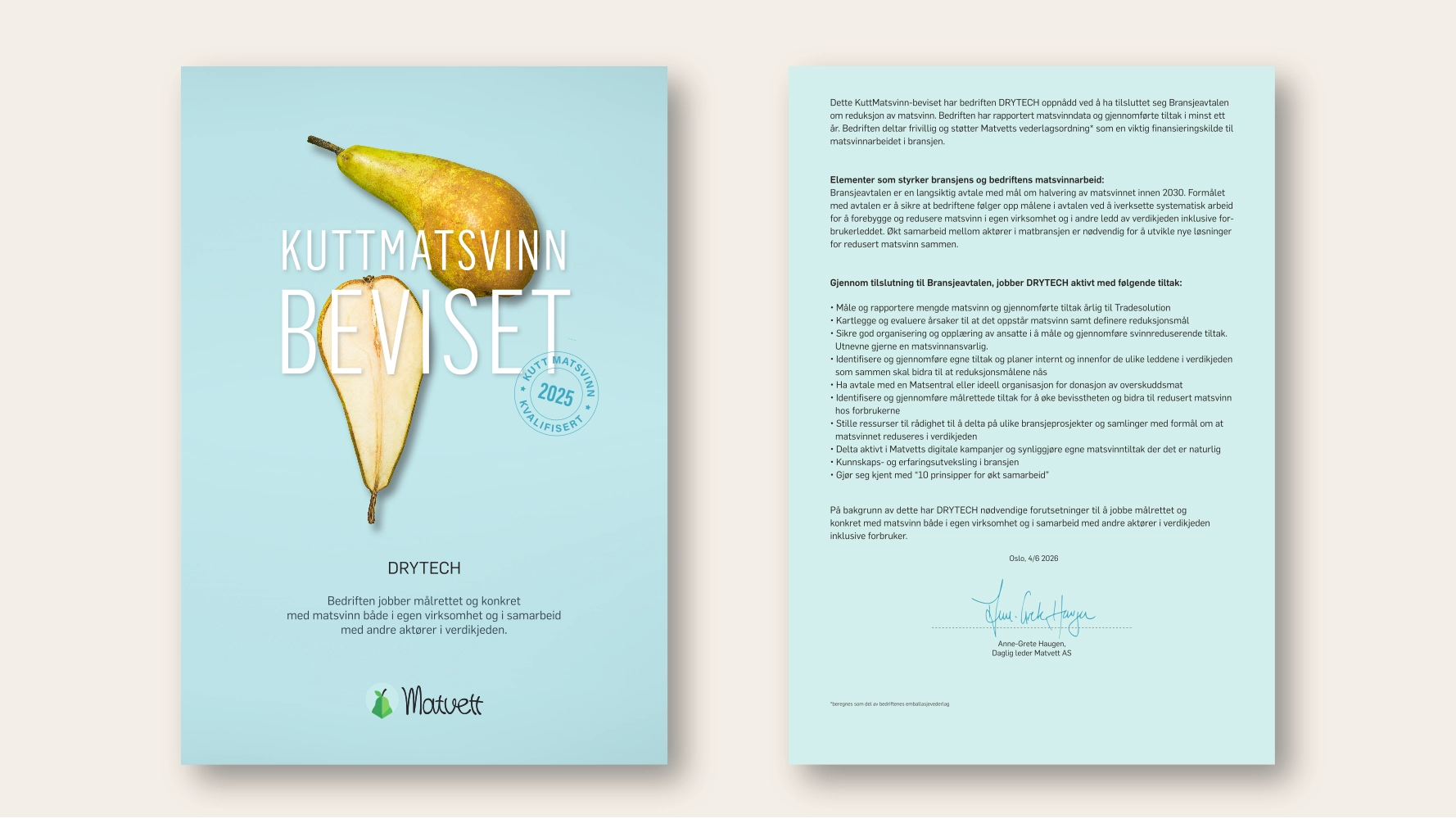
Drytech has significantly reduced food waste in recent years. Compared to the base year of 2020, the results for the first half of 2026 show a 62.5 percent reduction in food waste.
At Drytech, we make food from raw materials that require resources to grow, produce, and process. That is why it is important for us to make the most of every raw material. When less food goes to waste, we use resources more efficiently, reduce our environmental impact, and can produce more food with less waste.
How We Measure Food Waste in Production
To track trends over time, we measure food waste in grams of food waste per finished REAL bag. This means we look at how much food is wasted during production and compare this to the number of finished units we produce.
This measurement method makes it possible to compare results from year to year, even when production volume changes.
In 2020, food waste amounted to 8 grams per unit produced. So far in 2026, the level has been reduced to 3 grams per unit produced. This represents a 62.5 percent reduction compared to the base year.
The trend shows that, over time, we have managed to produce more REAL meals while significantly reducing the amount of food waste per unit produced.
The goal is a 55 percent reduction in food waste by 2030
Drytech aims to reduce food waste by 55 percent by 2030, compared with 2020.
The results for the first half of 2026 show that our measures are having an impact. While production has increased by 11 percent, the amount of food waste sent to our waste management provider has decreased by several metric tons.
This shows that increased production does not necessarily lead to a corresponding increase in food waste. By focusing our efforts on optimizing the use of raw materials and improving production processes, we can produce more food from the resources we already use
These results are made possible by our many food rescuers
Behind these results are many dedicated employees who work every day toward our common goal: We will never throw away food that is still edible.
The reduction in food waste is not the result of a single measure. It is the result of systematic improvement efforts, good procedures, and employees who care about the ingredients, production, and the resources we use.
Each individual contributes through both small and large decisions throughout the workday. This involves, among other things, following up on deviations, reducing waste, identifying opportunities for improvement, and ensuring that as much of the raw ingredients as possible actually becomes food.
It is these efforts that make it possible to increase production while reducing food waste.
It is an achievement we are proud of, and first and foremost, a recognition of the excellent work done every day by the people at Drytech.
Every ingredient counts
For Drytech, reducing food waste is both an environmental measure and an important part of its efforts to improve production.
When a larger proportion of our raw materials ends up as food and less goes to waste, we make better use of our resources. At the same time, we can reduce the environmental impact associated with, among other things, raw materials, transportation, energy, and waste management.
Our efforts to reduce food waste are achieved through continuous improvements in production, better utilization of raw materials, effective procedures, and increased awareness among our employees.
The ambition is clear:
We will grow and produce more, without food waste increasing in step with production.
Every raw material we make better use of is a step in the right direction.